Nurse Aide Training and Home Health Aide Program (NATP/HHTP)
Earn two credentials. Launch a meaningful career in healthcare — in just four weeks.

A Certified Nurse Aide (CNA) is one of the most essential members of any healthcare team. From hospitals and nursing homes to assisted living centers and private residences, CNAs are on the front lines of patient care every single day. They do far more than assist a Registered Nurse — they communicate with residents, observe and report changes in health status, ensure safety and comfort, and provide hands-on support with Activities of Daily Living (ADL). In short, they are the heartbeat of direct patient care.
At Royal Health Care Institute, our Dual Certificate Program takes it one step further. Students graduate with both a Nurse Aide Training certificate and a Home Health Aide certificate — two credentials, one program, and a world of career opportunities waiting on the other side.
Please note: All students are required to present a clean CORI (Criminal Offender Record Information) check and a negative TB test result prior to beginning clinical rotations.
Program Overview
Our Dual Certificate Program is designed for compassionate, hardworking individuals who are ready to step into one of the fastest-growing fields in healthcare. The curriculum follows the Federal and Massachusetts state-approved guidelines, ensuring that every graduate meets the required training standards — and then some.
This program doesn’t just prepare students to pass an exam. It prepares them to thrive in a real healthcare environment. Through a combination of classroom instruction, hands-on laboratory training, and supervised clinical experience, students build the confidence, skills, and knowledge they need to succeed from day one on the job.
Beyond the immediate career path, this program has also served as a launching pad for students who go on to pursue careers in nursing, physical therapy, occupational therapy, and other allied health professions. Many of our graduates describe this program as the moment their healthcare career truly began.
How The Program Works
Phase 1 — Classroom & Laboratory Instruction
The first phase combines classroom lectures with hands-on laboratory practice. Students are introduced to the theoretical foundations of nurse assisting, including anatomy basics, infection control, communication techniques, resident rights, and safety protocols. This phase is taught by experienced Registered Nurses who bring real-world insight into every lesson. By the end of Phase 1, students have a solid understanding of what to expect — and what is expected of them — in a clinical setting.
Phase 2 — Clinical Training
The second phase takes students out of the classroom and into a licensed long-term care facility, where they apply everything they’ve learned in a real healthcare environment. Under the supervision of qualified instructors, students work directly with patients, practice clinical skills, and develop the professional habits that employers value most. By the time Phase 2 is complete, graduates are fully prepared — and genuinely confident — to sit for the Massachusetts CNA Certification Examination.
What You Will Earn
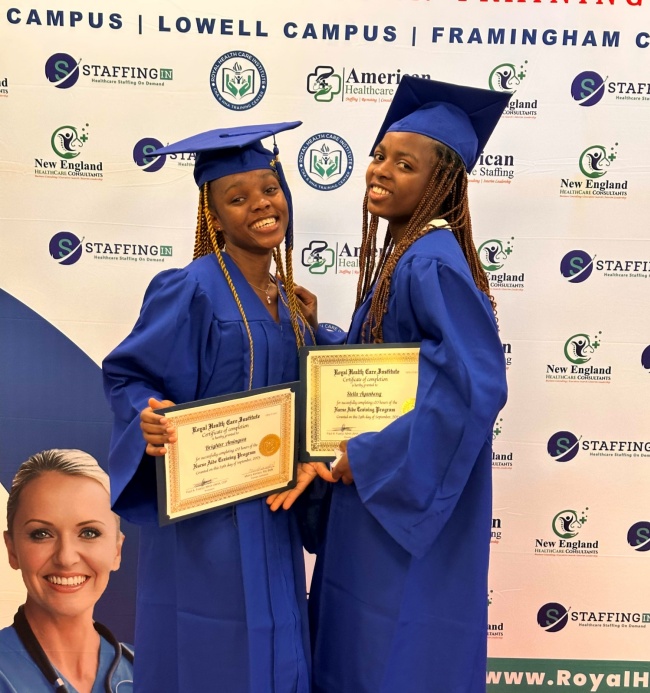
Students who successfully complete all classroom instruction, laboratory work, and clinical evaluations will receive a Certificate of Completion for the Nurse Aide Training Program. This certificate confirms that the graduate has met all required competencies and is eligible to sit for the Massachusetts CNA Certification Examination, administered through D&S Technologies (TMU).
Upon passing the state exam, graduates are officially listed on the Massachusetts Nurse Aide Registry — a credential recognized by healthcare employers across the Commonwealth. Combined with the Home Health Aide certificate earned through this same program, our graduates enter the workforce with a powerful, dual-credential advantage.
NATP/HHTP Course Outline
| Module | Topic |
| 1 | Overview of Healthcare & the CNA Role |
| 2 | Aging and Development |
| 3 | Residents’ Rights |
| 4 | Safety in Healthcare Settings |
| 5 | Activities of Daily Living (ADL) |
| 6 | The Resident’s Room |
| 7 | Observing and Reporting |
| 8 | Communication: Talking and Listening |
| 9 | Infection Control |
| 10 | Nutrition and Hydration |
| 11 | Mental Health of Residents |
| 12 | Self-Care for Healthcare Workers |
| 13 | Care of the Dying Resident |
| 14 | Home Health Aide Fundamentals |
| 15 | Dual Certificate Program Competencies |
Schedule & Class Options
This is a 120-hour program that runs Monday through Friday for four consecutive weeks. We offer two scheduling options to fit your lifestyle:
- Day Classes: Monday – Friday | 8:00 AM – 2:30 PM
- Evening Classes: Monday – Friday | 4:00 PM – 9:30 PM
Whether you’re transitioning careers, entering the workforce for the first time, or looking to expand your credentials, our schedule is built to make it possible.
Tuition & Fees
Total Program Tuition: $1,810.00
This all-inclusive tuition covers everything you need to complete the program:
- ✅ Textbooks and course materials
- ✅ Uniform
- ✅ CPR/BLS Training
- ✅ Dementia Training
- ✅ Cap & Gown (graduation)
- ✅ Technology Fee
Regarding the CNA Certification Exam:
- First-time testing is FREE for all Nurse Aide graduates, per the Massachusetts Department of Public Health (MA DPH), effective July 2024.
- If a second attempt is needed, the D&S Technologies (TMU) exam fee is $110, payable directly through the TMU portal at the time of scheduling.
There are no hidden fees. What you see is what you pay.
Our Faculty
Every instructor and staff member at Royal Health Care Institute is approved by the Massachusetts Division of Occupational Licensure (DOL), the Office of Private Occupational School Education, and the Massachusetts Department of Public Health (DPH).
Our faculty consists of highly qualified Registered Nurses (RNs) and Licensed Practical Nurses (LPNs) with extensive experience in long-term care, acute care, and community health settings. They are not just credentialed professionals — they are dedicated educators who understand what it takes to succeed in this field. Patient, organized, and culturally aware, our instructors bring genuine care and real-world experience to every classroom.
At Royal Health Care Institute, we believe that great healthcare professionals are shaped by great teachers. That’s the standard we hold ourselves to every day.